Today we went on a trip to a place called 6th of October. It is like a park with many special things to do. A few things that they have is horse riding, swimming, and soccer. First we went horse riding. We were going really slow but the horses started galloping a few times. Then we went to a place where we can start a barbecue. We did not want to just sit and wait for it so we went horse riding for thirty minutes more.  This time the horses were slower. After that we went to eat. Then after we ate me and one friend went to ride the horses one more time. This time since it was only the two of us the horses galloped at full speed.  The horses went really fast. After we rode the horses we went home.
Yesterday we had a trip to this place where you can ride horses, swim, and chill.. and of course I went to the horses a lot. It was an amazing experience riding the horses because of fast they went without stopping. I got scared of falling whenever the horse ran as fast as it could, but after a while I got used to it. But it was so fun! It was well worth the money and time! I hope I can ride again sooner...
                                                                  
Horse Riding


Example of the Rats in Egypt


That is not my only animal experience here in Egypt. I have had experience with 15 mice in the house, bugs, cats, etc. The mice were the hardest of our problems since they were everywhere, but fortunately we used traps and we caught all of them.


Since I have talked about the technical things of Egypt it is time to start talking about it's people. Most Egyptians are very nice people, Most of them greet you nicely, and they are generally very nice. They show great hospitality towards foreigners, as they are very social. Almost everybody is a friend to everyone else. These people are generally the best people I have ever seen.               

In Muslim culture: people greet each other by saying (السلام عليكم‎) “As-salamu alaykum”, which means “peace be upon you”. Even people that you might not know might greet you this way. If an Egyptian greets you with this words, You should be ready to respond "Wa-Alaikum-us-Salaam" ("and upon you the Peace"). These sayings are an important part of Muslim Culture. In-fact when we are late to our Arabic class becomes furious, however when we greet him this way, he smiles and says “Wa-Alaikum-us-Salaam”, then continues to get mad at us. Almost every Egyptian will respond to you if you greet them like this.
Egyptians also show much hospitality. If you were to be talking English in the streets they will hear you and try to talk English with you. There is a small store close to our house that sells food and such things, when I go to him, even though I speak Arabic with him he responds in English. The first time I went to the barber, the barber asked me where I was from, when I said I was from America he said “you honor us”. The Egyptian people show great welcoming towards strangers.
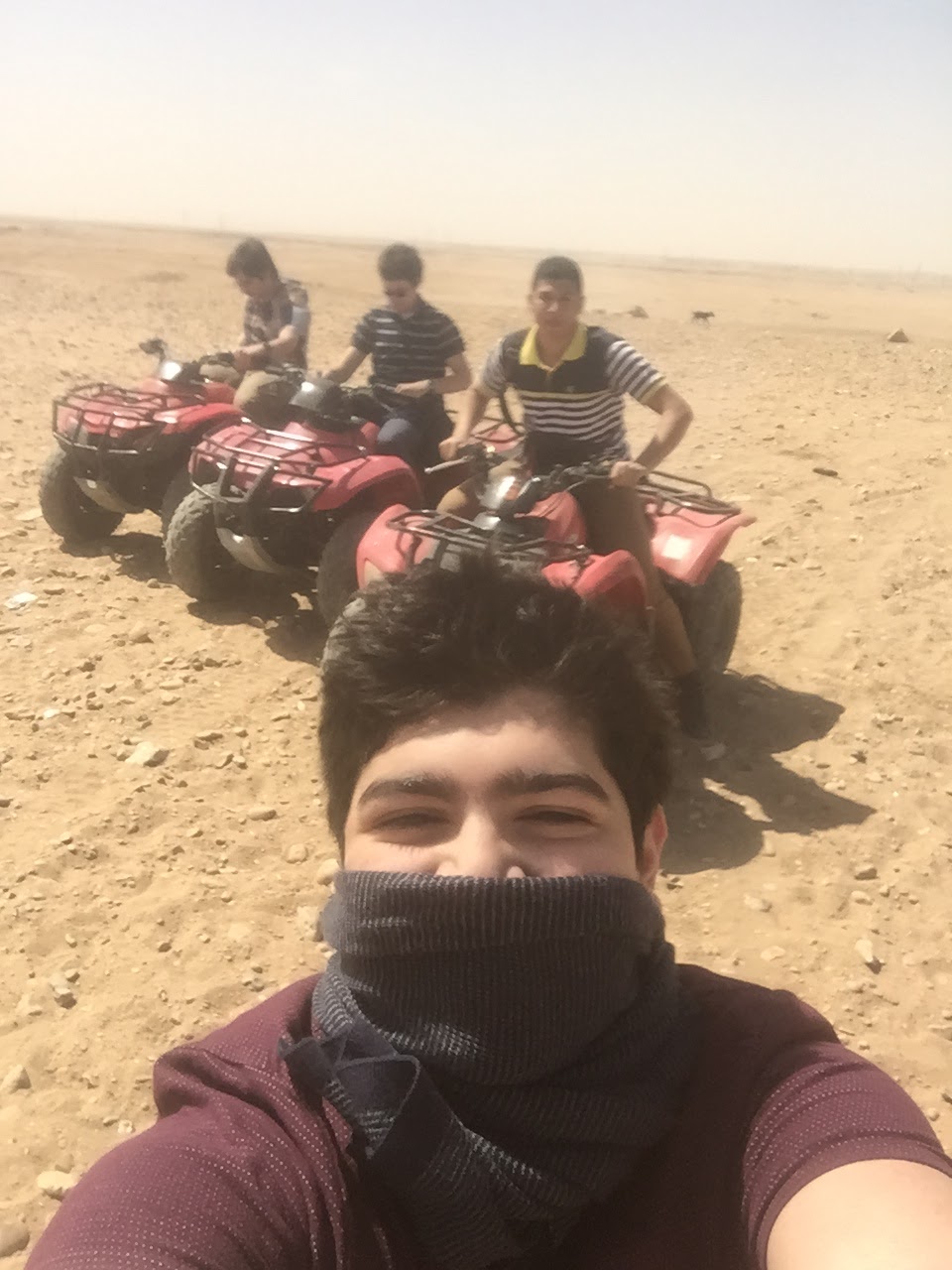
Here, everyone is a friend to everyone. When we were going to Giza to ride ATV's (by the way it was really fun. Riding towards to pyramids on the desert was amazing), on the way, our bus driver had to ask directions. He had to stop sometimes and everybody he talked to to ask the way, they talked as if they were close friends for years. In the meanwhile me and my friends were thinking about how our bus driver had too many friends. Almost everyone here is each others friend, and it is really easy to spark a conversation with somebody. One time we were going in the taxi to somewhere, the driver noticed we weren't Egyptian him and our supervisor had a friendly conversation about where we were from. It isn't very hard to make a friend here in Egypt.
Egyptians are very nice people that show great hospitality and kindness. They greet foreigners warmly. They are mostly very close with each other and refer to each other as “brother”. I'm not sure if it's because of the Arabic culture or the Egyptian touristic culture, however, I can say they are one of the the best nations I've met.
I have always had a thing for horses, and yesterday we decided to go horseback riding. The place we went was in another city one and a half hours from Cairo. When we arrived we bought tickets to ride on horses for half an hour. There was no one holding the reins so you were riding it yourself. After half an hour we were so pleased by this experience that we decided to go again. So we bought another ticket for thirty minutes. While our guardians were setting up the barbeque we were riding horses. After we were done riding and were finished eating, we started getting ready to leave. Just when we were about to we decided to mount the horses one more time, so we bought tickets only for fifteen minutes. However this time the workers hit the horses on the back with a whip and the horses were galloping. It was like a horse race where the horses were just non stop galloping full speed for three laps. Its was incredible and we had so much fun! Afterwords we got on the bus and drove back thinking about the day. I can confidently say that the long rode and money was totally worth it, especially for that last fifteen minutes.

I did not want to write about our atv ride but I wanted to share what happened to me. So we were riding all together in the desert with the pyramids behind us. Then I decided to try something different, so I made a sudden turn hoping to drift. However it did not go as planned and I fell of the atv. My ride was still going while I was on the ground. After I got up and cleaned myself I realized that my right knee had a rip and a small wound. I did not feel much pain so I got back on and continued riding.


The first time That we've came to Egypt the weather was warm, but Because of a recent sandstorm in the desert the city of cairo was in a huge dust cloud. So the blue sky was Replaced by a brown atmosphere. It Took the sky two weeks to clear. However recently another sandstorm occurred, and towards the night heavy winds struck the city so looking out from the window it looked like the sandstorm was right outside. These things do not Often happen here, but the strangest thing is that right after the winds stopped, a short thunderstorm with heavy rains fell upon us. Within the next morning the sky was clear and clean. Then I realized That if it had not rained right after the sandstorm, the sky would have been Polluted with dust and sand for at most two Weeks. However the rain washed off the dirt and left us with a pure and clear sky.

Picture of the dustcloud when we first came


So far it has been 6 months or so since I first cam to Egypt. I have learnt a decent amount of Arabic these past months and I noticed that Arabic is a language that can never be truly mastered. There is always more to learn. Anyways.. we had a field trip a couple days ago! We went to the Giza Pyramids and rode ATV's there. It was a great time and the view was so amazing, words cannot describe how much. There we had races together and the sand always hit me in the eye, that was the only unfortunate thing. So when we were riding around, my engine started stuttering and stopped. I started it back up and continued. This happened a couple times or so until it stopped working altogether. I was somewhat disappointed, but fortunately I rode another ATV instead of the broken one.

  But there has been one thing that I have been noticing a lot.. That is that not everyone is Muslim. There are Christians, Jewish, and Muslim in Egypt. Like a big mixing pot. But the thing is that the Christians are Arab! Which makes me think that not all Arabs are Muslim, which is a common idea nowadays..

       Since learning a new language gets hard, at break I go to the top of our school and get fresh air there and relax. It has a great view from there. Picture is down below!


View From the ATV
View of the Pyramids
With Friends
Riding
Picture I Took From the Top of our School


I want to first start off by saying that learning a new language is way harder than I thought. Especially a language as rich as arabic. However I could see that it would be even harder if the right preparations were not made. What are these preparations? From my observations I can say that the environment in which we chose to learn arabic, has a huge impact on our progression. 

I say this because everything around us is arabic. The people speak arabic, the signs are arabic, and all the radio and television channels are arabic. It's like the environment is forcing you to learn. Imagine an arabic class were you and your classmates are learning arabic. Then when you go out of class you still have to speak arabic to go anywhere or buy anything since the country speak arabic. I say that even though it might seem difficult and frustrating this is a great way to improve and practice.

 Now imagine the opposite. You are in an arabic class with classmates trying to learn arabic. However out of class you enter a different world, a world that everyone speaks english and you do not use what you have learned in class. That's what would have happened if we had decided to study arabic in America, and believe me it would take a very long time for us to learn the language even if we were determined. So overall the fact that the environment forces us to practice what we learn in class triples are learning speed and we would not have it any other way.

By: Hayreddin Kalac


Last week me and my friend bought 2 bunnies, A black and brown one. We named them Susu and Busu which are Egyptian nicknames.

For the first few days we were potty training them and trying to teach them tricks.  After a few days we had to get them a new box to live in because the first one got very dirty. When we did I Made windows in the box, but when I woke up they had bitten threw the windows and escaped. They had Also left there waste all over the room. After that we had to go to school so we left them there.

When we came back the room was a mess. We spent a few minutes cleaning but the person who stayed in our house with us said we can't keep them. He and his friends got the bunnies and cut them to eat. I guess bunnies are not pets in Egypt.


Most of us heard the term 'Petrodollars', This term has a respectful place and broadened reputation in economic glossary. It shortly means the money earned from the sale of oil. The term "petrodollars" was coined when the price of oil rose sharply in the 1970s. It resurfaced in the new millennium, when prices rose once again. Although petrodollars initially referred primarily to money that Middle Eastern countries received. 1

Middle east countries are referred as Arabs, so it is a common saying, a stereotype that all Arabs are “oil rich. Is it? Well it is not. Not all of them are actually like that. Let’s look at Egypt as an example.  Egypt is not oil rich, also since I live here I have asked my Egyptian teachers and friends: we will have a better understanding.

First of all we should point out that Egypt has the biggest oil deposits in Africa after OPEC. Despite this fact however, they are only 13th in the whole middle east and only produce  3.7 billion barrels. This may seem plenty, however it is nothing close to what the gulf countries in the middle east produce. For example Saudi Arabia produces about 262.3 billion barrels of oil, compared to this Egypt’s 3.7 billion shows that Egypt doesn’t produce that much oil, at least not enough to be compared with the gulf countries. Before, Egypt used to produce a lot of oil and also used to be a seller of it. However, the petroleum consumption in Egypt  increased by every passing year, and now it is more than the production. Now Egypt barely has enough oil for it’s own country, at the point where they have to buy petroleum now. This shows that not all Arabs are oil rich. Other countries that aren’t oil rich in the Middle East include Jordan and Morocco.


Despite the fact that Egypt doesn’t have much oil it has found other ways to make money. Main income sources are Tourism, the Suez Canal, and natural gas. Egypt's main exports consist of natural gas, and non-petroleum products such as ready-made clothes, cotton textiles, medical and petrochemical products, citrus fruits, rice and dried onion, and more recently cement, steel, and ceramics.2

One of the importand incomes of Egypt is tourism. Egypt is crazy with tourism, many people from all over the world  come to Egypt to see the pyramids or visit the vacation spot sharm al-shaykh. There are many places to visit and places to see, Egypt is a tourism paradise. Well, it used to be; see, after the Arab Spring on January 25, 2011 less and less people have been coming to Egypt in fear that something else might happen. Ever since those events Egypt has lost it’s tourism reputation. Even though the tourism in Egypt is like this, I really admire the way Egypt improvises for their lack of oil.
The Suez canal is a very large source of income for Egypt. The Suez canal is an artificial canal that connects lower Africa and Asia. This tunnel is a very strategic place for Egypt, for about 47 ships pass through each day, and last year 17,483 ships made full trips through The Suez canal (coming and going). About 104 different ship flags were represented last year, with 998,652 tons of  goods (2,736 tons daily). 3 We can see by this, how big of an income source the Suez canal is. The canal makes 4.9 billion dollars per year. The Suez Canal is a very important income source for Egypt.


In conclusion we can all see that not all middle east countries are “oil rich”. The ones without the oil improvise with other things. In my opinion Egypt is the best at this improvising.


1- http://www.investopedia.com/terms/p/petrodollars.asp

2- https://en.wikipedia.org/wiki/Economy_of_Egypt

3- http://www.theguardian.com/business/2011/feb/01/suez-canal-egypy-q-and-a
 I've been in Egypt for 4 months now, and I think I have an idea about this country and it's people in terms of education and knowledge. I have observed that, anyone who comes from a first world country like myself, can realize some major differences between their country and Egypt or anywhere in the Middle-East. Anyone who comes to the middle east can notice that it is left behind.

As an American, I can notice many big differences between the two countries.

An example of this is when we called a mechanic to fix the heater and he used a USB cable to patch some cable. I found myself in that tv show “MacGyver “ It was on air before I was born I heard about it and watched some youtube’s. That guy was a guy of nothing and everything at the same time. He was finding solutions to his desperate situations from any ordinary things by mixing or gathering them together. was this guy MacGyver of Cairo? this can be thought of as a good thing or a bad thing for Egypt. The positive point of view is that these people know their job so well that they can fix a heater with only a USB cable. However the negative perspective is that: this guy's profession is this, and he comes to fix the heater without any tools, in fact he took that USB from me! This man specializes in this area however he has not disciplined himself and doesn't carry around with him the necessary tools. There is an obvious lack of principled people. Another thing that happened to me which was just like this: when I was sick I went to the doctor, they had mostly everything however, you know those lights they put in your mouth to check it? Instead of using that, he used his own Nokia phone's flashlight. It was same, lack of the correct materials. This is how life goes on in Egypt, mostly everywhere is like this.

USB Cable Dangling.

After all of this you might be thinking Egypt full of unlearned the people , However they're not. In Egypt there are more learned people than unlearned. Here are some educational facts.
The public education system in Egypt is well developed as a hub of education not only for Egypt, but for the whole Arab world. Today, Cairo is the center for many government offices governing the educational system. The city has the largest number of schools and institutions of higher education in Egypt. The Government of Egypt has placed high priority on improving the education system and is directed by the Ministry of Education of Egypt. With the support of the World Bank and other multilateral organizations Egypt is increasing the quality of its education. 1
Al-Azhar University, the premier center of religious instruction in the Islamic world, is said to be the oldest continuously operating university in the world. Post-secondary education has been free in Egypt since 1962. 2
Cairo University ranked 345 in the world, founded in 1908, produces the country's largest number of college graduates and college-educated professionals. It has about 155,000 students and 3,158 faculty members, operates some 100 research institutes and offers programs in agriculture, medicine, nursing, economics, political science, the arts, and other fields. 2
In Front of Book Fair.
A Soldier in Book Fair.
Every year Egypt hosts a huge book fair (which I have went to) where about 2,000,000 people come from all over the Arab world called “Cairo International Book Fair". This book fair is also the second largest book fair in the world after the Frankfurt book fair. The Cairo international book fair is also the oldest book fair in the Arab world. The fact that Egypt hosts this book fair is directly proof that the Egyptian people are not without knowledge.

So, why Egypt economically ranked 127 out of 157 countries? 3 Is there a solution to this beautiful country’s “USB Guy” problem?
I believe these people know what they need to know. Education is a well appreciated thing in Egypt. It may because these people have the knowledge but don't apply them. In arabic the word for knowledge is “علم" (read ilm). And there is also another word which lives at the same street to “ilm” . “عمل" (read amel) means action. The doing of the “ilm”.
These people have the “ilm” but they don’t have the “amel”. These people have good education but is it real education? Real education should be teaching people the knowledge and that they should be putting the knowledge into action. If they put it in action then that "USB guy" will discipline himself and carry around with him the necessary tools. In conclusion, I think what Egypt needs is “True education”. They should gather the “ilm”knowledge and the “amel” action. This may be the true solution. How can knowledge be one with action? Well, it is another story.
Hi I am Recep Erciyas. I am pretty sure I made one my biggest life choices....by going to Egypt!
Egypt, one of the worlds most cultural influences..
Everything there is a complete mystery. everythig is completely different from what I have imagined it in my head. There are many differences with the imagined Cairo and reality Cairo. Like for an example I thought there was going to luxury surrounding me, which is not the case of course. There are old buildings and cars. But there is a good to every bad. 

To start, everyone there are like friends even if they do not know each other. Once I was walking home from school and i saw two cars colliding. I thought there was going to be a big commotion between the drivers, but they both just said sorry, gave some money, and left. Strange, right? First week I was here, I went to get snacks and when I was paying I noticed i did not have enough money on me. The cashier noticed and shrugged it off saying "You can pay later." I was shocked upon hearing this and on how much they trust each other. To sum it up, this is what makes Egypt unique.

      I've been in Cairo for about four months now, I'm improving my language every day. 
When I first came to Cairo I struggled, not knowing the language. Also there were a few thing that seemed weird to me, for example instead of garbage trucks there are donkey carts that have huge baskets attached to it. After a month of struggling I finally started getting used to life. Every month seemed to be going faster.
      On the second month we went to the pyramids. we woke up early to get our residence, so if a soldier asks for our passports we won't have problems. After waiting two hours we ate lunch and then went to the pyramids. The area was very crowded. we took a few picture then tried to clime the pyramids. Then after that we rode camels. Finally after a long day we headed home.
Cairo (/ˈkaɪroʊ/ KYE-roh; Arabic: القاهرة‎, al-Qāhirah) is the capital and largest city of Egypt. Greater Cairo is the largest metropolitan area in the Middle East and the Arab world, and 15th-largest in the world, and is associated with ancient Egypt, as the famous Giza pyramid complex and the ancient city of Memphis are located in its geographical area. Located near the Nile Delta,[1][2] modern Cairo was founded in 969 CE by Jawhar al-Siqilli (“the Sicilian”) of the Fatimid dynasty, but the land composing the present-day city was the site of ancient national capitals whose remnants remain visible in parts of Old Cairo. Cairo has long been a center of the region’s political and cultural life, and is nicknamed “the city of a thousand minarets” for its preponderance of Islamic architecture.
Egyptians today often refer to Cairo as Maṣr ([mɑsˤɾ], مصر), the Egyptian Arabic pronunciation of the name for Egypt itself, emphasizing the city’s continued role in Egyptian influence.[3][4] Its official name is القاهرة al-Qāhirah , means literally: “the Defeater”, in reference to the fact that the planet Mars (“Al Najm Al Qahir”) was rising at the time when the city was founded[citation needed] as well as, “the Vanquisher”; “the Conqueror”; Egyptian Arabic pronunciation: [elqɑ(ː)ˈheɾɑ], “the Defeater” or, ” “the Victorious” (al-Qahira) in reference to the much awaited[5] Caliph al-Mu’izz li Din Allah who arrived from the old Fatimid Ifriqiyan capital of Mahdia in 973 to the city. The Egyptian name for Cairo is said to be: Khere-Ohe, meaning: “The Place of Combat”, supposedly, in reference to a battle which took place between the Gods Seth and Horus.[6] Sometimes the city is informally also referred to as كايرو Kayro [ˈkæjɾo].[7] It is also called Umm ad-Dunya, meaning “the mother of the world”.[8]
Cairo has the oldest and largest film and music industries in the Arab world, as well as the world’s second-oldest institution of higher learning, al-Azhar University. Many international media, businesses, and organizations have regional headquarters in the city; the Arab League has had its headquarters in Cairo for most of its existence.
With a population of 6.76 million[9] spread over 453 square kilometers (175 sq mi), Cairo is by far the largest city in Egypt. An additional 10 million inhabitants live just outside the city. Cairo, like many other mega-cities, suffers from high levels of pollution and traffic. Cairo’s metro, one of only two metros on the African continent (the other Algiers), ranks among the fifteen busiest in the world,[10] with over 1 billion[11] annual passenger rides. The economy of Cairo was ranked first in the Middle East[12] in 2005, and 43rd globally by Foreign Policy‘s 2010 Global Cities Index.[13]