Even if egypt might not be the best County in the world every country has its specialties that make it different. Since egypt is a Muslim country it has quran playing every where.  If you go to the market you will most likely hear quran in the market and on your way there. It is a nice characteristic of Egypt.


Also in Egypt adhan is recited.  Even if some of them aren't so great egypt is also the country with the best adhans if you ask me. The reason some of the adhans aren't so great is because the door men are the ones reading some of them, but if you go to a famous masjid you will hear great adhans.
I’ve been in Cairo for the last 7 months. When I first came I had some troubles getting used to Egypt and the culture. Thankfully, now I’m pretty much used to Egypt except for one thing: the trash. Ever since I came to Cairo the one thing that always bothered me is the dirtiness. Cairo is trash, some places have less trash some places have more. There are literally empty lots full of trash; Behind my house! I haven’t seen the Egyptian countryside however, based on Cairo one might think all of Egypt to be like this. Well, this is how I though until I went to Shamoussa.

Trash Everywhere
I was very excited, there was going to be a trip to a vacation spot with my friends. We were going to have so much fun there. I couldn’t stop thinking about how great this vacation was going to be. But then, another though came to me: “what if that place s trash too, what if the sea is full of trash?” I was already concerned even though my friends that had went before said it was clean. Nevertheless I went; the trip was 3 hours long on a bus, and during that time we did small cultural shows where one would sing a song from their country and so on.

Shamoussa is a village in  Ismailia “The city of beauty and Enchantment” It is right on the bitter lake. Bitter lake is a lake on Suez Canal. We got there at about 10 o’clock and we went in through the entrance. I was finally going to see what kind of place Shamoussa was. After I got in I was greeted with this: 


It was beautiful! Probably the best place I’ve went to in Egypt. The red sea looked awesome and the grass; I had never seen green grass like that before in Egypt. The pool water also looked very nice.

My friends and I got ready to go into the water. So we decided to go to the sea first, and spoiler alert: BIG MISTAKE. Every couple seconds something would prick our feet, and after the painful adventure we were greeted by holes and wounds. After realising our big mistake we decided to stick to the pools. We were having a blast diving, cannonballing, and trying to drown each other; we had so much fun.  I probably swam 6 hours that whole day. At lunch we ate delicious sandwiches. After that some of us went back to swim and some stayed out. After a whole day of fun we went home at 6 pm with great amounts of pain.

I guess I had thought wrong about Egypt, not everywhere is dirty. And when you fid that perfect spot it really turns out to be worth it for the trash. I look forward to going back to Shamoussa...
There are people in this world, kids especially, that do very important things very young. The sooner a person starts focusing on their spike, their main talent, the better it is for him or her in the future. In this case these kids were the kids in the Arabic culture festival. This event was useful for the contestants and the spectators alike. This event is something so magical, so sweet; the sharing of cultures and learning about them, these types of festivals are truly wonderful. 

Before I go into detail about the festival I went to, I would like to go into more detail about how useful and wonderful these shows are. The idea of showing your traditions and learning about others and the dialogue between different cultures is very important. By doing these kind of shows people can learn about, remember, and practice their traditions. These kind of things are what keep tradition alive. In the recent years people have been forgetting their trues selves, their traditions. Keeping traditions alive is important for teaching the next generation about a particular or shared past and for helping  individuals to establish identity. I’ve seen people that have forgotten their traditions and customs; If you don't protect your customs and traditions it is as if you have become one of another nation. Tradition is what defines a nation. These festivals help to keep hundreds of year old traditions alive.

It was a Saturday, which is basically Sunday for non-Arab countries. Normally on Saturdays we take special math and science classes, however this Saturday was different; we were going to go to an Arabic Festival. Not only was this an opportunity  to practice Arabic, it was also an opportunity to be more familiar with Arab and Egyptian culture. We woke up early in the morning and got ready, we wore our best clothes and set off to the international school where the festival would take place. Once we got there I could understand how big of a thing this was going to be, judging by the big crowd. We entered the theatre and sat down, I was already getting excited.

Boom! Woosh! There were fire effects on the stage and the show had started. First there was an intro video that described the purpose of this festival and what was going to happen. Then a speaker went on stage and called some teachers. Afterwards he told everybody to stand for the Egyptian national anthem. The show then started with two students singing a song about the culture of Egypt. One demonstration that I enjoyed a lot was the play. The play was apparently a story from Arab tradition. The story was about a wise man called "sheikh al-faqir", which means the poor old man. This man was very religious Muslim, however was very poor. His friends family complained about him being this way and his wife said that their kids were starving. This man was normally very religious however said "I do all these prayers and read all this Quran, for what!? My family is hungry and I've not seen any help from Allah! If by tomorrow I don't find food in my house I swear that I wont read a single ayat from Allah's ayats! (Ayat is a small small section of the Quran)". Upon hearing this their friends got very worried so they decided to make a plan. Every person was to bring something from their houses as food; some brought juice, some ;brought meat, and some brought bread. They gathered all these things and put it in the old man's house. The next day upon finding this food the man repented the sins that he had done by saying those other things and him and his family lived happily after that. Other than that there were poems and dances.. At the end of the festival we feasted traditional Arab/Egyptian foods.
        
 Overall the festival was stunning and I learned many things about Arab and Egyptian culture; Not just from the performances, but also from the people that were watching. I still cannot stress how important these sorts of things are. If the world wants peace they need tolerance, and for tolerance you need a good understanding of somebody’s culture. These programs are just steps towards world peace.


Simpler to the Turkish olimpiads the Arabic language festival is a festival where Egyptians and people from all around the world sing songs in Arabic. This event was on Saturday last week. We only took two hours of class that day so we could go. The event took place at salahadin international school a nice school in new cairo. It was supposed to start at 12:00 but it started thirty minutes late. When they finally started they gave a speech and sent the contestants. All of them sang good. It was a great event, and was organized pretty good.
Hello, I recently did an interview with someone that has a great knowledge in Egyptian economy.


1: How do you see the Egypt’s economy in future? 
"The economy is sluggish right now and it seems difficult for the economy to recover soon as the situation is getting worse day by day. Unfortunately, it doesn't seem to have a bright future."

2: How does Egypt generate its income? (What are the sources of income for Egypt?)
"Well! It used to get a lot of income from the Suez Canal, but now it is closed (sealed) for the tourists and media. It used to get huge media attraction as Egypt had been the Hollywood of the Middle East."

3: Is it possible for the economy to recover?
"Theoretically yes, but it would take hard work to do so. Actually, people here are not productive and hardworking, and it shows they won’t be in future too."

4: Does dollar have a role in the economy?
"Dollar is a very important currency for the economy from business perspective. It is used to buy goods from other countries, but since we only import and not export, dollar is rare and expensive."
        For most of us Sundays are "fundays". Everybody wants to sleep, rest, and just generally wants to have a good time. However for us, we have to go to school on Sunday. Yes, it might seem weird, but in some Muslim countries the work week is from Sunday to Thursday. I know you might be feeling bad for us, but when think about it, it just makes Fridays two times better and Thursday not that bad of a day. The only bad part is that Saturday becomes like a Sunday...

       Well, one Sunday I woke up, feeling how you guys feel on Mondays, but that wasn't the worst part. The worst part is that Sundays are my days that I make the breakfast in the house. Getting out early to buy supplies and being deprived my two hours of sleep in the morning is not my definition of a good day. Nevertheless I had to do it, so I got ready and went to ask money for the breakfast from my friend ( who handles the financial things), however this time he asked me to buy him some things also. He gave me 100 LE (Egyptian pounds).  I told him that this was too much money for the things I was going to buy, but he said that it would be a good way to change the money (into smaller bills)

        So I'm here, on  Sunday (Monday) in an Arab country at the age of 14, and I barely know how to talk. Money in hand I walked to the store. "How hard could it be?" I asked myself, "all you have to do is just give the guy the money and he gives you the change and you leave." However I still had this thought that he would ask me something I wouldn't understand.

        On the road I was thinking about what I would say to the worker there, and all of the situations and combinations  that could happen. I walked worriedly, as I was newbie to Arabic. But didn't expect this would be one of my most embarrassing and confusing memories in Egypt.

         Once I got there the man at the counter was already looking at me weird. I was worried that he would ask something I wouldn't understand. After I was done buying the eggs, bread and other breakfast materials, I went to the counter and gave him the 100 LE. He counted the total price of the products and asked "fekkah?" ,  it was a word I didn't know, I was trying to figure out what it could mean. Yes that was exactly what I worried for. After seeing that I clearly didn't understand, the man then showed me a one pound coin and said  fekkah! Fekkah! Again. At that moment we were both trying to understand each other. I thought he was saying that I paid short. However on afterthought I thought that It couldn't be because 100 LE would be enough for all of the things I bought. So I told him that I paid him 100 LE. This time the guy got really mad (probably because I wasn't understanding that so simple, and that it was very early in the morning, or on second thought it was because it was Sunday). He whipped the coin that was in his hand into a box, this time he said angrily "fekkah!". I still couldn't understand, I thought that maybe he means that I can pay the rest of the price of the items later. So I left the money, took the bags and went out...

        Lucky for me there was a kind old lady that called me back, this time they were both trying to make me understand. After a while the shop owner just gave up and gave me the change of 100 LE . I left embarrassed.

         At home my  friend asked me why I took so long. So I told him the story. I hardly kept myself from saying "told you see, I told you that 100 LE bill was too much". After my story was over he smiled and said "fekkah" means change...

       (The shops here don't want to give exact change, if you paid for 15.50 LE with a 20 LE bill the guy would say "fekkah?" And you would give 50 piasters coin and he would give you back 5 LE...)

     Today we went on a trip to a place called 6th of October. It is like a park with many special things to do. A few things that they have is horse riding, swimming, and soccer. First we went horse riding. We were going really slow but the horses started galloping a few times. Then we went to a place where we can start a barbecue. We did not want to just sit and wait for it so we went horse riding for thirty minutes more.  This time the horses were slower. After that we went to eat. Then after we ate me and one friend went to ride the horses one more time. This time since it was only the two of us the horses galloped at full speed.  The horses went really fast. After we rode the horses we went home.
Yesterday we had a trip to this place where you can ride horses, swim, and chill.. and of course I went to the horses a lot. It was an amazing experience riding the horses because of fast they went without stopping. I got scared of falling whenever the horse ran as fast as it could, but after a while I got used to it. But it was so fun! It was well worth the money and time! I hope I can ride again sooner...
                                                                  
Horse Riding


Example of the Rats in Egypt


That is not my only animal experience here in Egypt. I have had experience with 15 mice in the house, bugs, cats, etc. The mice were the hardest of our problems since they were everywhere, but fortunately we used traps and we caught all of them.


Since I have talked about the technical things of Egypt it is time to start talking about it's people. Most Egyptians are very nice people, Most of them greet you nicely, and they are generally very nice. They show great hospitality towards foreigners, as they are very social. Almost everybody is a friend to everyone else. These people are generally the best people I have ever seen.               

In Muslim culture: people greet each other by saying (السلام عليكم‎) “As-salamu alaykum”, which means “peace be upon you”. Even people that you might not know might greet you this way. If an Egyptian greets you with this words, You should be ready to respond "Wa-Alaikum-us-Salaam" ("and upon you the Peace"). These sayings are an important part of Muslim Culture. In-fact when we are late to our Arabic class becomes furious, however when we greet him this way, he smiles and says “Wa-Alaikum-us-Salaam”, then continues to get mad at us. Almost every Egyptian will respond to you if you greet them like this.
Egyptians also show much hospitality. If you were to be talking English in the streets they will hear you and try to talk English with you. There is a small store close to our house that sells food and such things, when I go to him, even though I speak Arabic with him he responds in English. The first time I went to the barber, the barber asked me where I was from, when I said I was from America he said “you honor us”. The Egyptian people show great welcoming towards strangers.
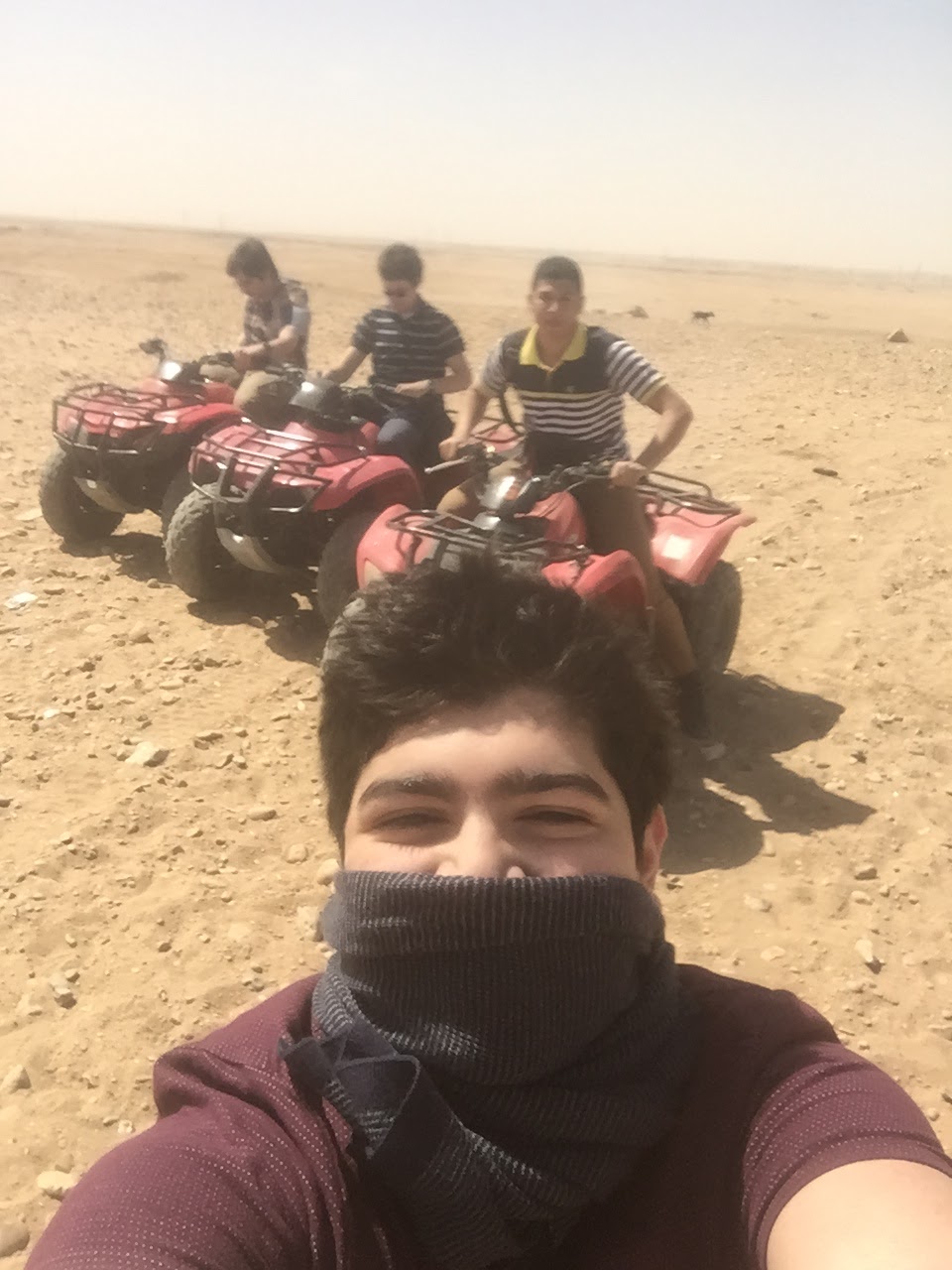
Here, everyone is a friend to everyone. When we were going to Giza to ride ATV's (by the way it was really fun. Riding towards to pyramids on the desert was amazing), on the way, our bus driver had to ask directions. He had to stop sometimes and everybody he talked to to ask the way, they talked as if they were close friends for years. In the meanwhile me and my friends were thinking about how our bus driver had too many friends. Almost everyone here is each others friend, and it is really easy to spark a conversation with somebody. One time we were going in the taxi to somewhere, the driver noticed we weren't Egyptian him and our supervisor had a friendly conversation about where we were from. It isn't very hard to make a friend here in Egypt.
Egyptians are very nice people that show great hospitality and kindness. They greet foreigners warmly. They are mostly very close with each other and refer to each other as “brother”. I'm not sure if it's because of the Arabic culture or the Egyptian touristic culture, however, I can say they are one of the the best nations I've met.
I have always had a thing for horses, and yesterday we decided to go horseback riding. The place we went was in another city one and a half hours from Cairo. When we arrived we bought tickets to ride on horses for half an hour. There was no one holding the reins so you were riding it yourself. After half an hour we were so pleased by this experience that we decided to go again. So we bought another ticket for thirty minutes. While our guardians were setting up the barbeque we were riding horses. After we were done riding and were finished eating, we started getting ready to leave. Just when we were about to we decided to mount the horses one more time, so we bought tickets only for fifteen minutes. However this time the workers hit the horses on the back with a whip and the horses were galloping. It was like a horse race where the horses were just non stop galloping full speed for three laps. Its was incredible and we had so much fun! Afterwords we got on the bus and drove back thinking about the day. I can confidently say that the long rode and money was totally worth it, especially for that last fifteen minutes.

I did not want to write about our atv ride but I wanted to share what happened to me. So we were riding all together in the desert with the pyramids behind us. Then I decided to try something different, so I made a sudden turn hoping to drift. However it did not go as planned and I fell of the atv. My ride was still going while I was on the ground. After I got up and cleaned myself I realized that my right knee had a rip and a small wound. I did not feel much pain so I got back on and continued riding.


The first time That we've came to Egypt the weather was warm, but Because of a recent sandstorm in the desert the city of cairo was in a huge dust cloud. So the blue sky was Replaced by a brown atmosphere. It Took the sky two weeks to clear. However recently another sandstorm occurred, and towards the night heavy winds struck the city so looking out from the window it looked like the sandstorm was right outside. These things do not Often happen here, but the strangest thing is that right after the winds stopped, a short thunderstorm with heavy rains fell upon us. Within the next morning the sky was clear and clean. Then I realized That if it had not rained right after the sandstorm, the sky would have been Polluted with dust and sand for at most two Weeks. However the rain washed off the dirt and left us with a pure and clear sky.

Picture of the dustcloud when we first came


So far it has been 6 months or so since I first cam to Egypt. I have learnt a decent amount of Arabic these past months and I noticed that Arabic is a language that can never be truly mastered. There is always more to learn. Anyways.. we had a field trip a couple days ago! We went to the Giza Pyramids and rode ATV's there. It was a great time and the view was so amazing, words cannot describe how much. There we had races together and the sand always hit me in the eye, that was the only unfortunate thing. So when we were riding around, my engine started stuttering and stopped. I started it back up and continued. This happened a couple times or so until it stopped working altogether. I was somewhat disappointed, but fortunately I rode another ATV instead of the broken one.

  But there has been one thing that I have been noticing a lot.. That is that not everyone is Muslim. There are Christians, Jewish, and Muslim in Egypt. Like a big mixing pot. But the thing is that the Christians are Arab! Which makes me think that not all Arabs are Muslim, which is a common idea nowadays..

       Since learning a new language gets hard, at break I go to the top of our school and get fresh air there and relax. It has a great view from there. Picture is down below!


View From the ATV
View of the Pyramids
With Friends
Riding
Picture I Took From the Top of our School


I want to first start off by saying that learning a new language is way harder than I thought. Especially a language as rich as arabic. However I could see that it would be even harder if the right preparations were not made. What are these preparations? From my observations I can say that the environment in which we chose to learn arabic, has a huge impact on our progression. 

I say this because everything around us is arabic. The people speak arabic, the signs are arabic, and all the radio and television channels are arabic. It's like the environment is forcing you to learn. Imagine an arabic class were you and your classmates are learning arabic. Then when you go out of class you still have to speak arabic to go anywhere or buy anything since the country speak arabic. I say that even though it might seem difficult and frustrating this is a great way to improve and practice.

 Now imagine the opposite. You are in an arabic class with classmates trying to learn arabic. However out of class you enter a different world, a world that everyone speaks english and you do not use what you have learned in class. That's what would have happened if we had decided to study arabic in America, and believe me it would take a very long time for us to learn the language even if we were determined. So overall the fact that the environment forces us to practice what we learn in class triples are learning speed and we would not have it any other way.

By: Hayreddin Kalac


Last week me and my friend bought 2 bunnies, A black and brown one. We named them Susu and Busu which are Egyptian nicknames.

For the first few days we were potty training them and trying to teach them tricks.  After a few days we had to get them a new box to live in because the first one got very dirty. When we did I Made windows in the box, but when I woke up they had bitten threw the windows and escaped. They had Also left there waste all over the room. After that we had to go to school so we left them there.

When we came back the room was a mess. We spent a few minutes cleaning but the person who stayed in our house with us said we can't keep them. He and his friends got the bunnies and cut them to eat. I guess bunnies are not pets in Egypt.


Most of us heard the term 'Petrodollars', This term has a respectful place and broadened reputation in economic glossary. It shortly means the money earned from the sale of oil. The term "petrodollars" was coined when the price of oil rose sharply in the 1970s. It resurfaced in the new millennium, when prices rose once again. Although petrodollars initially referred primarily to money that Middle Eastern countries received. 1

Middle east countries are referred as Arabs, so it is a common saying, a stereotype that all Arabs are “oil rich. Is it? Well it is not. Not all of them are actually like that. Let’s look at Egypt as an example.  Egypt is not oil rich, also since I live here I have asked my Egyptian teachers and friends: we will have a better understanding.

First of all we should point out that Egypt has the biggest oil deposits in Africa after OPEC. Despite this fact however, they are only 13th in the whole middle east and only produce  3.7 billion barrels. This may seem plenty, however it is nothing close to what the gulf countries in the middle east produce. For example Saudi Arabia produces about 262.3 billion barrels of oil, compared to this Egypt’s 3.7 billion shows that Egypt doesn’t produce that much oil, at least not enough to be compared with the gulf countries. Before, Egypt used to produce a lot of oil and also used to be a seller of it. However, the petroleum consumption in Egypt  increased by every passing year, and now it is more than the production. Now Egypt barely has enough oil for it’s own country, at the point where they have to buy petroleum now. This shows that not all Arabs are oil rich. Other countries that aren’t oil rich in the Middle East include Jordan and Morocco.


Despite the fact that Egypt doesn’t have much oil it has found other ways to make money. Main income sources are Tourism, the Suez Canal, and natural gas. Egypt's main exports consist of natural gas, and non-petroleum products such as ready-made clothes, cotton textiles, medical and petrochemical products, citrus fruits, rice and dried onion, and more recently cement, steel, and ceramics.2

One of the importand incomes of Egypt is tourism. Egypt is crazy with tourism, many people from all over the world  come to Egypt to see the pyramids or visit the vacation spot sharm al-shaykh. There are many places to visit and places to see, Egypt is a tourism paradise. Well, it used to be; see, after the Arab Spring on January 25, 2011 less and less people have been coming to Egypt in fear that something else might happen. Ever since those events Egypt has lost it’s tourism reputation. Even though the tourism in Egypt is like this, I really admire the way Egypt improvises for their lack of oil.
The Suez canal is a very large source of income for Egypt. The Suez canal is an artificial canal that connects lower Africa and Asia. This tunnel is a very strategic place for Egypt, for about 47 ships pass through each day, and last year 17,483 ships made full trips through The Suez canal (coming and going). About 104 different ship flags were represented last year, with 998,652 tons of  goods (2,736 tons daily). 3 We can see by this, how big of an income source the Suez canal is. The canal makes 4.9 billion dollars per year. The Suez Canal is a very important income source for Egypt.


In conclusion we can all see that not all middle east countries are “oil rich”. The ones without the oil improvise with other things. In my opinion Egypt is the best at this improvising.


1- http://www.investopedia.com/terms/p/petrodollars.asp

2- https://en.wikipedia.org/wiki/Economy_of_Egypt

3- http://www.theguardian.com/business/2011/feb/01/suez-canal-egypy-q-and-a
 I've been in Egypt for 4 months now, and I think I have an idea about this country and it's people in terms of education and knowledge. I have observed that, anyone who comes from a first world country like myself, can realize some major differences between their country and Egypt or anywhere in the Middle-East. Anyone who comes to the middle east can notice that it is left behind.

As an American, I can notice many big differences between the two countries.

An example of this is when we called a mechanic to fix the heater and he used a USB cable to patch some cable. I found myself in that tv show “MacGyver “ It was on air before I was born I heard about it and watched some youtube’s. That guy was a guy of nothing and everything at the same time. He was finding solutions to his desperate situations from any ordinary things by mixing or gathering them together. was this guy MacGyver of Cairo? this can be thought of as a good thing or a bad thing for Egypt. The positive point of view is that these people know their job so well that they can fix a heater with only a USB cable. However the negative perspective is that: this guy's profession is this, and he comes to fix the heater without any tools, in fact he took that USB from me! This man specializes in this area however he has not disciplined himself and doesn't carry around with him the necessary tools. There is an obvious lack of principled people. Another thing that happened to me which was just like this: when I was sick I went to the doctor, they had mostly everything however, you know those lights they put in your mouth to check it? Instead of using that, he used his own Nokia phone's flashlight. It was same, lack of the correct materials. This is how life goes on in Egypt, mostly everywhere is like this.

USB Cable Dangling.

After all of this you might be thinking Egypt full of unlearned the people , However they're not. In Egypt there are more learned people than unlearned. Here are some educational facts.
The public education system in Egypt is well developed as a hub of education not only for Egypt, but for the whole Arab world. Today, Cairo is the center for many government offices governing the educational system. The city has the largest number of schools and institutions of higher education in Egypt. The Government of Egypt has placed high priority on improving the education system and is directed by the Ministry of Education of Egypt. With the support of the World Bank and other multilateral organizations Egypt is increasing the quality of its education. 1
Al-Azhar University, the premier center of religious instruction in the Islamic world, is said to be the oldest continuously operating university in the world. Post-secondary education has been free in Egypt since 1962. 2
Cairo University ranked 345 in the world, founded in 1908, produces the country's largest number of college graduates and college-educated professionals. It has about 155,000 students and 3,158 faculty members, operates some 100 research institutes and offers programs in agriculture, medicine, nursing, economics, political science, the arts, and other fields. 2
In Front of Book Fair.
A Soldier in Book Fair.
Every year Egypt hosts a huge book fair (which I have went to) where about 2,000,000 people come from all over the Arab world called “Cairo International Book Fair". This book fair is also the second largest book fair in the world after the Frankfurt book fair. The Cairo international book fair is also the oldest book fair in the Arab world. The fact that Egypt hosts this book fair is directly proof that the Egyptian people are not without knowledge.

So, why Egypt economically ranked 127 out of 157 countries? 3 Is there a solution to this beautiful country’s “USB Guy” problem?
I believe these people know what they need to know. Education is a well appreciated thing in Egypt. It may because these people have the knowledge but don't apply them. In arabic the word for knowledge is “علم" (read ilm). And there is also another word which lives at the same street to “ilm” . “عمل" (read amel) means action. The doing of the “ilm”.
These people have the “ilm” but they don’t have the “amel”. These people have good education but is it real education? Real education should be teaching people the knowledge and that they should be putting the knowledge into action. If they put it in action then that "USB guy" will discipline himself and carry around with him the necessary tools. In conclusion, I think what Egypt needs is “True education”. They should gather the “ilm”knowledge and the “amel” action. This may be the true solution. How can knowledge be one with action? Well, it is another story.